How to Choose a 51.2V 160Ah LFP Battery?
Choosing a 51.2 V 160Ah LFP battery starts with a simple calculation: nominally, it stores about 8.19 kWh. That is substantial. But it is only nominal. The energy available to your home or equipment depends on the battery’s permitted depth of discharge, inverter settings, and reserve requirements. A label alone cannot tell you how long a fridge, pump, or workshop tool will run.
The market is growing quickly. The International Energy Agency’s Batteries and Secure Energy Transitions report (2024) says global energy storage capacity needs to increase sixfold, reaching 1,500 GW by 2030, in its net-zero pathway. That wider shift makes careful product selection more important, not less. Compare continuous discharge current with your inverter’s needs, then check surge limits, BMS protections, operating temperature, cycle-life test conditions, warranty terms, and compatibility with existing equipment. Ask whether quoted cycle life reflects a stated depth of discharge and temperature; otherwise, comparisons can mislead. I would not treat “long life” as a complete specification.
For 51.2 V 160ah Lfp Batteries, look beyond capacity and price. Confirm the usable energy stated in the datasheet, the communication protocol, and whether parallel expansion is supported. Check the actual model documentation, not just a sales summary. Those details matter. A well-matched battery can provide dependable service, but no specification removes the need to assess your real load profile. Even careful buyers can miss that step.
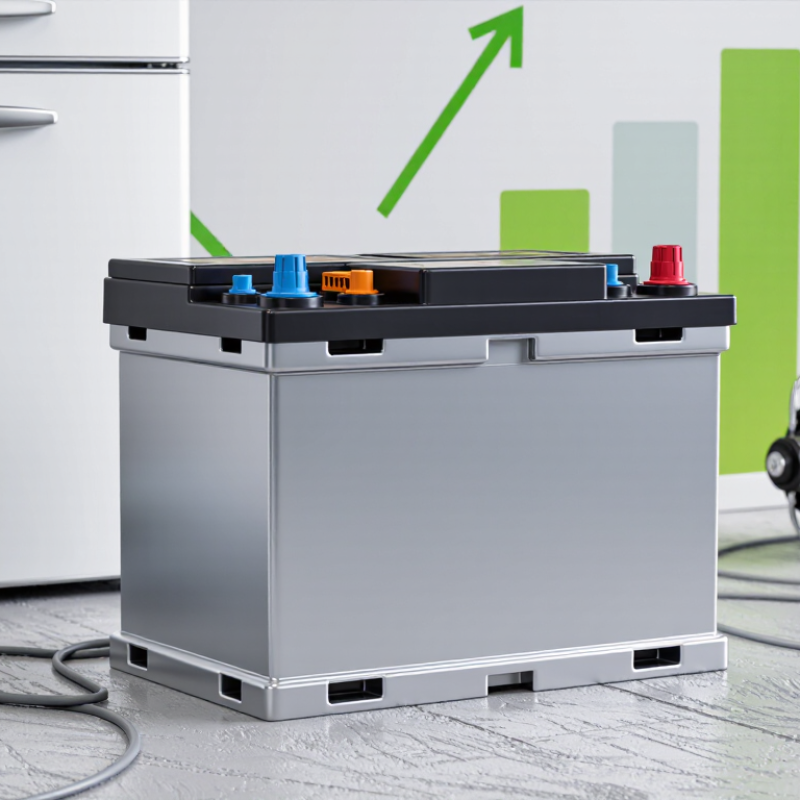
Understand the Battery’s Voltage, Capacity, and Energy Rating
A 51.2V 160Ah LFP battery has a nominal energy rating of 8.192kWh: voltage multiplied by amp-hours gives watt-hours. In practice, think of it as about 8.2kWh before limits and losses, not a promise of 8.2kWh available to every appliance. The U.S. Energy Information Administration distinguishes power, measured in kilowatts, from energy, measured in kilowatt-hours. That difference matters: a battery’s kWh figure describes stored energy, while its discharge rating helps determine how much equipment it can run at once. The label alone is not enough.
Check the manufacturer’s stated usable capacity, permitted depth of discharge, continuous current, and operating temperature. For example, a 2kW load might theoretically run for about four hours on 8.2kWh, but actual runtime will be shorter if the system reserves capacity or loses energy in conversion. NREL’s 2024 Annual Technology Baseline uses an 85% round-trip efficiency assumption for utility-scale battery storage; this is a system-level modeling value, not a guaranteed efficiency for a particular home battery. Installation conditions and inverter choice can change results. A small, often overlooked detail: confirm that the battery’s voltage range matches the inverter, not just its nominal 51.2V rating. I would still treat any runtime estimate as approximate. Real loads fluctuate, and labels rarely tell the whole story.
Calculate Your System’s Power and Runtime Requirements
How to Choose a 51.2V 160Ah LFP Battery?
Calculate Your System’s Power and Runtime Requirements
A 51.2V, 160Ah battery stores about 8.2kWh of nominal energy: 51.2 multiplied by 160. That figure is a starting point, not guaranteed usable power. Account for the battery’s recommended discharge limit, inverter efficiency, and reserve capacity. Check the product specifications rather than assuming every stored watt-hour will reach your appliances.
List each device, its wattage, and daily operating hours. A 100W refrigerator running for 10 hours uses roughly 1kWh; a 600W appliance running for two hours uses another 1.2kWh. Add the estimates, then allow room for startup surges and changing usage. Small details count. A pump may draw much more power when its motor starts.
For runtime, divide usable battery energy by the combined load. If your setup provides about 7kWh after operating limits and conversion losses, a steady 1kW load might run for around seven hours. Real results vary. I’ve found early estimates can look reassuringly tidy, but cold conditions, inverter idle consumption, and cycling loads complicate them. Also confirm the battery’s continuous discharge rating: a 3kW load draws about 59A at 51.2V, before losses. Check that the battery and inverter can support both that current and any brief surge.
How to Choose a 51.2V 160Ah LFP Battery? - Calculate Your System’s Power and Runtime Requirements
| Category | Metric or Example | Calculation or Assumption | Result |
| Battery Capacity and Planning Values |
| Nominal voltage | 16-cell-series LFP battery | 16 cells × 3.2V nominal per cell | 51.2V |
| Rated capacity | Battery capacity | As specified for this battery configuration | 160Ah |
| Nominal energy | Stored energy at nominal voltage | 51.2V × 160Ah | 8,192Wh (8.192kWh) |
| Planning energy at 90% depth of discharge | Estimated usable DC energy | 8.192kWh × 0.90 | 7.373kWh |
| Estimated AC energy | Usable energy after inverter losses | 7.373kWh × 90% assumed inverter efficiency | 6.636kWh |
| Nominal 1C current reference | Capacity-based current reference only | 160Ah × 1C | 160A |
| Example Runtime Estimates for AC Loads |
| Light load | 500W | 6.636kWh ÷ 0.500kW | About 13.3 hours |
| Small appliance group | 1,000W | 6.636kWh ÷ 1.000kW | About 6.6 hours |
| Medium load | 1,500W | 6.636kWh ÷ 1.500kW | About 4.4 hours |
| High load | 2,000W | 6.636kWh ÷ 2.000kW | About 3.3 hours |
| Very high load | 3,000W | 6.636kWh ÷ 3.000kW | About 2.2 hours |
| Approximate Battery Current at Nominal Voltage |
| 500W AC load | With a 90% efficient inverter | 500W ÷ (51.2V × 0.90) | About 10.9A |
| 1,000W AC load | With a 90% efficient inverter | 1,000W ÷ (51.2V × 0.90) | About 21.7A |
| 2,000W AC load | With a 90% efficient inverter | 2,000W ÷ (51.2V × 0.90) | About 43.4A |
| 3,000W AC load | With a 90% efficient inverter | 3,000W ÷ (51.2V × 0.90) | About 65.1A |
Runtime figures are estimates based on 90% depth of discharge and 90% inverter efficiency. Actual runtime varies with battery limits, inverter efficiency, load surges, temperature, battery age, wiring losses, and operating conditions. Before choosing an inverter or battery, verify the battery’s specified continuous and peak discharge current and the BMS limits; the 1C value above is a calculation reference, not a guaranteed discharge rating.
Check Cell Quality, BMS Limits, and Safety Protections
How to Choose a 51.2V 160Ah LFP Battery?
Cell quality is more than a grade printed on a sheet. Ask whether cells are matched for capacity and resistance, and whether the supplier can provide test records and traceability. Check the stated operating temperature range, cycle-life test conditions, and capacity tolerance. Those details help you judge whether published figures reflect realistic use. A tidy specification sheet is not proof of long-term consistency. Small details matter.
Review the battery management system (BMS) limits against your inverter and charger. Confirm continuous and peak charge and discharge currents, not just the headline capacity. A 160Ah rating describes stored charge; it does not tell you how much current the pack can safely deliver. Check for cell balancing and protections against overvoltage, undervoltage, overcurrent, short circuits, and excessive temperature. Do not guess. If the BMS limit is lower than the inverter’s demand, the system may shut down under load.
Safety also depends on the whole installation. Look for clear guidance on terminal covers, cable sizing, ventilation, and temperature monitoring. Confirm that charging voltage settings suit the battery’s specifications, especially in cold conditions. LFP chemistry is generally stable, but it is not risk-free. I would also ask how the battery behaves after a protection trip; that point is easy to overlook, and product documents may not explain it clearly.
Confirm Compatibility with Inverters, Chargers, and Installation Space
A 51.2V, 160Ah battery stores about 8.19kWh nominally; usable energy may be lower. Check the inverter’s supported battery voltage range, not just its “48V” label. A 5kW load draws roughly 98A at 51.2V before conversion losses, so compare that demand with the battery’s continuous discharge rating. Also check surge limits for motors and pumps. Close, but not always enough.
The battery management system and inverter must agree on charge limits and communication settings. Confirm CAN or RS485 support where required, and use a charger profile intended for lithium iron phosphate. Disable lead-acid equalization unless the battery maker explicitly allows it.
Space and charging conditions matter just as much. Measure the actual enclosure, cable-bend space, access for servicing, and required ventilation or clearances; a neat-looking fit can still be a poor one. Check the floor or wall can support the battery’s weight, and keep it within the manufacturer’s temperature limits. NREL’s 2024 Annual Technology Baseline uses 85% round-trip efficiency for utility-scale lithium-ion storage. Treat that as a planning benchmark, not a home-battery guarantee. Real system performance depends on inverter losses, operating temperature, and charge rate. Leave room for inspection. Before purchase, compare the battery and inverter manuals line by line; I would not rely on a seller’s “compatible” label alone.
Compare Certifications, Warranty, and Long-Term Costs
When comparing a 51.2V 160Ah LFP battery, treat certification documents as evidence, not decoration. A certificate should identify the exact model and match its intended use. Check applicable standards, such as IEC 62619 for industrial lithium batteries or UN 38.3 for transport testing. Requirements vary by market and installation. Ask for a test report or verifiable certificate number. A logo alone is not enough. Small detail, big difference.
Warranty length matters, but the conditions matter more. Check the covered years, cycle limit, minimum retained capacity, and claim process. Confirm whether coverage depends on specific charging temperatures or inverter settings. It is easy to focus on cycle count and overlook operating limits. I would not assume the longest warranty offers the strongest protection.
Estimate long-term cost by dividing the purchase price by usable energy over the battery’s expected life. Include shipping, installation, compatible equipment, and possible downtime or replacement costs. Compare usable capacity, not just the stated 160Ah figure. Ask how capacity is measured and under what conditions. Even a careful comparison can miss details; unclear warranty language deserves a written answer before purchase.
How to Choose a 51.2V 160Ah LFP Battery: Certifications, Warranty, and Long-Term Costs
Illustrative comparison of purchase price and warranty coverage for three hypothetical 51.2V 160Ah battery offers. These figures are example assumptions, not verified market quotes or product specifications.
What to check: Request certification documents for the exact battery model and intended use. Relevant standards may include UL 1973 or IEC 62619 for battery safety, and UN 38.3 test documentation for transport. Confirm warranty duration, capacity-retention terms, cycle-life conditions, exclusions, and who pays shipping or labor.
A longer warranty does not guarantee a longer service life. For a meaningful long-term cost comparison, include usable capacity, cycle-life test conditions, expected daily energy use, replacement costs, and any installation or service charges. A 51.2V × 160Ah battery has a nominal energy capacity of 8.192 kWh.

