Who Are the Top Lithium Battery Pack Manufacturers in China?
China’s battery industry is large, but “top manufacturer” can mean different things: cell output, pack integration, safety testing, or long-term supply capability. The distinction matters. A strong cell does not automatically make a dependable Lithium battery pack; thermal management, battery management systems, and quality control also shape performance.
The International Energy Agency’s Global Supply Chains of EV Batteries report (2022) estimated that China held about 75% of global battery-cell manufacturing capacity, alongside leading shares in cathode and anode production. That concentration helps explain the scale of companies such as CATL, BYD, EVE Energy, Gotion High-Tech, CALB, and Sunwoda. Yet rankings shift with the measure used and the year examined. Public figures are not always directly comparable.
Benchmark Mineral Intelligence founder Simon Moores has described lithium as “the new oil,” a phrase that captures its strategic importance, though lithium alone does not define pack quality. Buyers should also examine application experience, certification records, warranty terms, and traceable test data. Look closely at the details.
This guide compares leading Chinese manufacturers through those practical lenses. It also recognizes an imperfect reality: published capacity figures can be easier to find than independently verified pack-level performance. Readers should treat rankings as a starting point, not a substitute for technical due diligence.
Define Lithium-Ion Battery Pack Manufacturers and Their Supply-Chain Roles
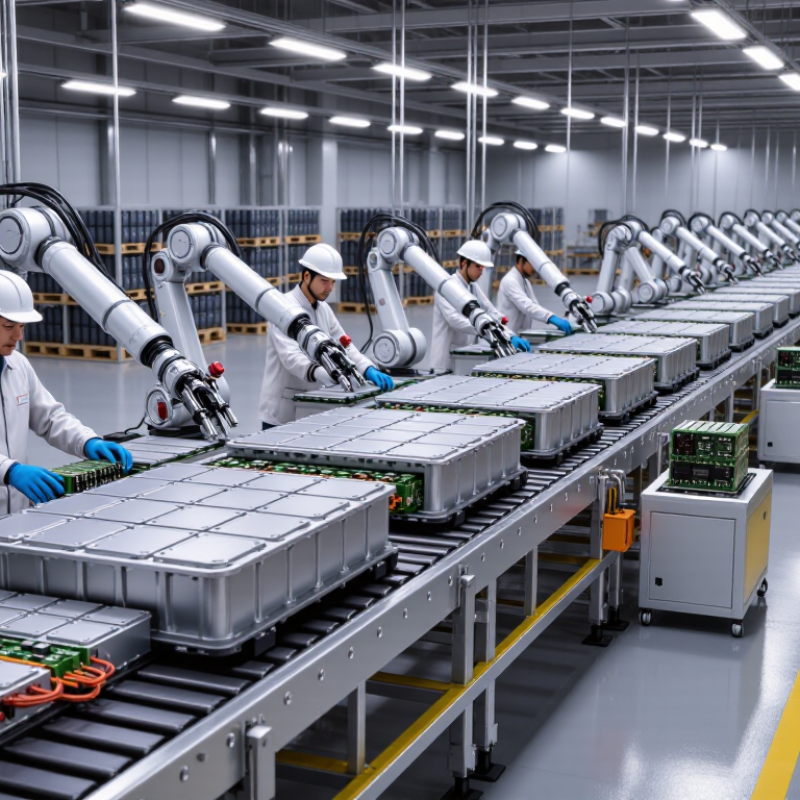
Lithium-ion battery pack manufacturers turn individual cells into complete, usable power systems. They select compatible cells, arrange them into modules, and connect them with wiring, sensors, and a battery management system. A protective enclosure helps shield the pack from dust, impact, and moisture. The final design depends on its application, such as an electric vehicle, energy storage cabinet, or portable tool. That distinction matters.
Their supply-chain role sits between cell suppliers and equipment makers. Manufacturers may specify cell dimensions, capacity, and performance, then verify incoming materials before assembly. On the production line, workers or automated equipment connect cells, inspect joints, fit insulation, and install temperature sensors. Engineers test voltage, charging behavior, and protective functions before shipment. They may also coordinate with customers on connectors, mounting points, and operating conditions. Not every manufacturer controls every step; some outsource components or testing. A neat supply-chain diagram can hide these differences.
Tips: Ask who supplies the cells, what tests each pack receives, and how results are recorded. Request clear specifications for capacity, voltage, and operating temperature. Small gaps in documentation matter. A well-built pack can still be a poor fit if its dimensions or protection settings do not match the equipment.
China Installed 387.7 GWh of EV Batteries in 2023; LFP Reached 67.2% (CABIA)
China installed 387.7 GWh of electric-vehicle batteries in 2023, according to CABIA. Lithium iron phosphate (LFP) accounted for 67.2% of that capacity. This points to a market where LFP is no longer a niche choice. It has become central to many vehicle and battery-pack plans. The numbers describe installed capacity, not every pack produced or sold, so they should be read carefully.
For pack manufacturers, LFP’s scale brings practical demands: consistent cell matching, reliable thermal management, and careful quality checks across large production runs. LFP is often selected for its durability and cost profile, while other chemistries may suit different range or performance targets. No chemistry wins in every application. A high market share also does not prove that each pack delivers the same safety, lifespan, or real-world range. Those outcomes depend on design, manufacturing controls, and use conditions. The 2023 figures offer a useful snapshot, but they cannot answer every buyer’s question. More detail would help.
Compare CATL (43.1%) and BYD (27.2%) by 2023 China Installation Share (CABIA)
China’s 2023 power-battery installation figures show a concentrated market. The China Automotive Battery Innovation Alliance (CABIA) reported a 43.1% share for the leading manufacturer and 27.2% for the second. Together, they accounted for 70.3% of domestic installations. That is substantial. The figures describe installed capacity in China, not global sales, factory output, or export volume. CABIA also reported 387.7 GWh of total installed power-battery capacity for the year, giving the percentages a useful domestic context.
For buyers and supply-chain analysts, the gap matters: the leader’s share was 15.9 percentage points higher. Yet share alone cannot show cell performance, pack design, pricing, or delivery reliability. Those details require separate checks. A fleet operator, for example, may care about service coverage and charging needs more than market rank. One caveat: installation data records batteries fitted to vehicles, not every order placed that year. That distinction is easy to miss—and worth checking twice. The two figures are a strong snapshot, but not a complete measure of manufacturer quality.
Profile CALB, Gotion, EVE, and Sunwoda Across Key Pack Applications
China’s lithium battery pack manufacturers work across very different applications. Some focus on passenger electric vehicles, where packs must fit tightly beneath the cabin floor and deliver dependable range. Others supply buses, trucks, or industrial equipment, where durability and predictable charging matter more than a slim profile. A pack is not just cells in a box. Its cooling paths, wiring, enclosure, and control software all affect performance.
In the automotive segment, manufacturers such as those represented by CALB, Gotion, and EVE are often compared through energy density, safety design, production scale, and vehicle compatibility. But a specification sheet rarely tells the whole story. A fleet operator may care more about service access and charging schedules than maximum range. Small details count. A poorly placed connector can complicate routine inspection.
Sunwoda’s profile also reflects the breadth of pack applications, including vehicle systems and compact products. Energy storage packs face another set of demands: steady output, thermal monitoring, and years of repeated cycling. Buyers should ask how a pack behaves under local temperatures and real operating loads, not just ideal laboratory conditions. Comparisons can be useful, yet they can oversimplify. The right choice depends on the application, and sometimes the available evidence is incomplete.
Compare Pack Chemistry, Design, BMS, Safety, and Warranty Factors
When comparing lithium battery pack manufacturers in China, start with chemistry, not headline capacity. Lithium iron phosphate suits frequent cycling and tighter thermal margins; nickel-rich chemistries can offer greater energy density where space is limited. The International Energy Agency reported global electric-vehicle battery demand reached about 750 GWh in 2023, up roughly 40% year on year. That scale makes cell sourcing and chemistry consistency worth checking. Chemistry matters.
Look closely at pack design: cell spacing, compression, busbar protection, enclosure sealing, and heat paths. Ask for test results on vibration, temperature extremes, and repeated charge cycles—not just a polished specification sheet. BloombergNEF’s 2024 survey put average lithium-ion pack prices at $115 per kWh, down 20% from 2023. Lower cost is useful, but it does not prove equivalent materials or service life. Small details matter.
A capable battery management system should monitor cell voltage and temperature, balance cells, and record fault events. Request sample logs and confirm how the system responds to sensor failure or abnormal temperatures. Safety claims should name test methods and provide traceable reports, ideally covering cell, module, and finished-pack tests. Warranty terms need equal scrutiny: check covered years or cycles, retained-capacity thresholds, exclusions, and who handles replacements. A long warranty can still leave gaps. I would compare the written terms against the intended duty cycle; that step is easy to skip, and it can reveal assumptions no brochure mentions.

