Top 10 Automotive Cable Suppliers for Global Buyers
Choosing an automotive cable supplier is rarely as simple as comparing prices on a spreadsheet. Global buyers must examine conductor quality, insulation performance, temperature resistance, flexibility, and traceability. A cable may look identical in a catalog, yet perform differently inside a hot engine compartment.
This guide introduces ten automotive cable suppliers serving international markets. It focuses on practical buying evidence, including manufacturing experience, product range, testing capability, certifications, and delivery reliability. Supplier evaluations should also consider copper purity, terminal compatibility, jacket materials, and production controls. These details affect voltage stability, vibration resistance, assembly time, and long-term vehicle safety.
Real purchasing decisions are less perfect. Very few suppliers excel in every region, vehicle platform, and order quantity. Some offer advanced engineering support but require higher minimum volumes. Others provide competitive pricing but limited customization. Buyers should verify current certificates, factory capacity, sample results, and after-sales responsiveness before signing contracts. A strong reputation helps, but documented performance matters more.
Look beyond marketing claims. Ask for test reports.
The selected companies are presented as a practical starting point, not an unquestionable ranking. Market conditions, raw material costs, logistics, and regulatory requirements can change quickly. Careful comparison remains essential, especially for buyers sourcing low-voltage wires, high-temperature cables, battery connections, or customized harness components. With clear specifications and supplier audits, this overview can help purchasing teams reduce avoidable risks and select automotive cable partners with greater confidence.
How Automotive Cable Suppliers Serve Global Vehicle Manufacturers
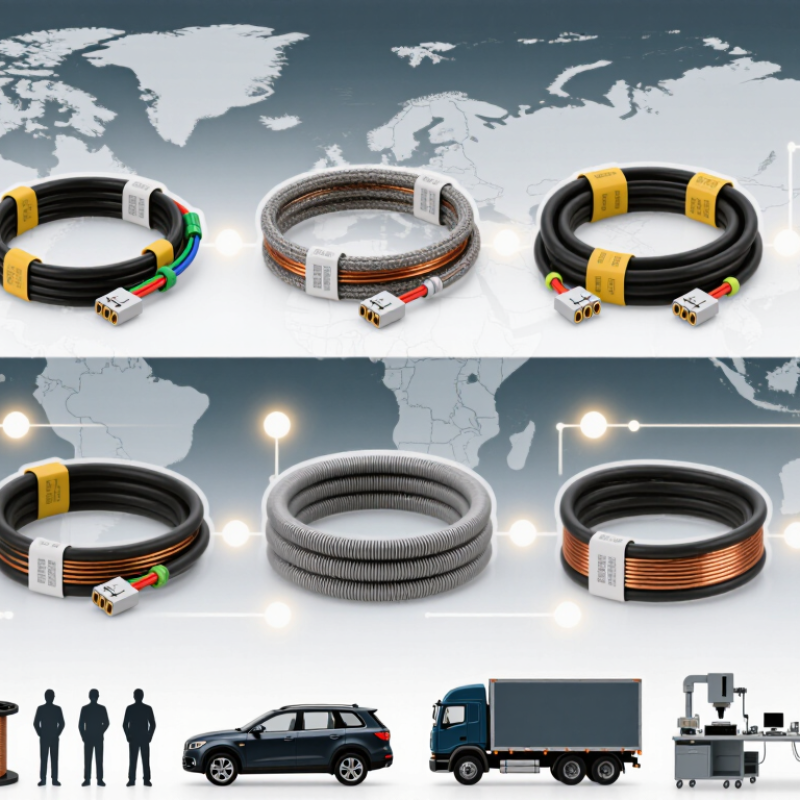
Global vehicle production demands cable suppliers that can scale without sacrificing consistency. OICA reported approximately 93.5 million motor vehicles produced worldwide in 2023. Each vehicle requires carefully engineered power, signal, sensor, and data connections. Suppliers support manufacturers through regional plants, synchronized delivery schedules, and traceable quality systems.
Electric vehicles are raising the technical standard. The International Energy Agency recorded nearly 14 million electric car sales in 2023, representing about 18% of global car sales. High-voltage cables need strong insulation, shielding, and resistance to heat, vibration, and chemical exposure. Low-voltage harnesses must also manage crowded spaces around batteries, inverters, and driver-assistance systems. Small details matter. A poorly secured cable can create noise, wear, or production delays.
Reliable suppliers offer more than finished cable assemblies. They provide prototype support, terminal selection, testing, and engineering changes across multiple factories. The AIAG quality framework and IATF 16949 remain important references for automotive process control. However, compliance alone is not enough. A supplier may pass an audit yet struggle during a sudden volume increase. This is where practical experience matters: clear drawings, sample approvals, pull-force tests, and real-time shipment visibility reduce avoidable risk. McKinsey’s automotive research continues to highlight software, electrification, and supply-chain resilience as major industry priorities. Cable suppliers must respond accordingly, although many still need better transparency in raw-material sourcing and regional capacity planning.
Key Criteria for Evaluating Automotive Cable Suppliers
Selecting an automotive cable supplier requires more than comparing unit prices. OICA reported 93.5 million motor vehicles produced globally in 2023. The IEA’s Global EV Outlook 2024 recorded almost 14 million electric car sales in 2023. These volumes increase pressure on insulation quality, delivery stability, and traceable production.
Start with documented process control. Check IATF 16949 certification, material batch records, crimp-force monitoring, and test reports for voltage, resistance, abrasion, heat, and flame performance. For high-voltage systems, request evidence covering thermal cycling, vibration, water ingress, and dielectric strength. A supplier should explain its test method, sample size, and failure limits clearly. Vague certificates are warning signs.
Look at engineering response, not only factory capacity.
Can the supplier adjust conductor geometry for tight bends? Can it provide cross-sections, terminal pull-force results, and controlled prototypes within a defined schedule? The supplier should also demonstrate change management and lot-level traceability. A barcode linked to copper, insulation, operator, and test data is more useful than a glossy presentation. However, certification alone can mislead. A polished audit file may hide weak problem-solving on the production floor. Buyers should inspect actual lines, review nonconformance records, and ask how a rejected cable is contained. I would also score communication speed, because a technically strong supplier that answers after several days may still disrupt launch timing.
Profiles of the Top 10 Automotive Cable Suppliers
Top 10 Automotive Cable Suppliers for Global Buyers
Profiles of the Top 10 Automotive Cable Suppliers
The ten supplier profiles represent different strengths in automotive cable production. Some focus on battery cables and high-current assemblies. Others specialize in sensor wires, control cables, or compact data connections. Strong suppliers usually operate controlled extrusion lines, automated crimping stations, and stable testing laboratories. Their teams should explain conductor materials, insulation choices, temperature ratings, and bending limits clearly. Experience matters when cables face vibration, oil exposure, moisture, and repeated movement inside vehicles.
Several profiles stand out through traceability. They can identify production batches, inspection records, and material sources without hesitation. Reliable suppliers also provide dimensional reports, electrical test results, and sample approval procedures. Compliance with recognized automotive quality systems can support buyer confidence. Yet paperwork is not everything. A polished certificate cannot repair weak communication or inconsistent factory control. This is where buyers need to look closer.
Tips: Request samples from different production batches. Test them under realistic heat, vibration, and routing conditions. Ask how rejected cables are isolated and recorded. Check response times before signing a long-term agreement. Consider total cost, not only the quoted unit price. A cheaper cable may create installation delays or early failures. No supplier profile is flawless. Even experienced manufacturers may need improvement in documentation, forecasting, or custom design support. Ask direct questions, and keep written evidence of every technical promise.
Product Capabilities, Certifications, and Regional Coverage Compared
Top 10 Automotive Cable Suppliers for Global Buyers
A strong supplier comparison should examine product depth, certification control, and regional support. The leading ten suppliers typically offer battery cables, shielded data cables, high-voltage EV cables, sensor wires, and complete cable assemblies. Some also support custom conductor sizes, thin-wall insulation, heat resistance, oil resistance, and tight bending radii. These details matter inside crowded engine bays and compact battery packs.
Certification evidence separates capable manufacturers from attractive sales claims. Buyers should verify current IATF 16949 and ISO 9001 certificates, while ISO 14001 supports environmental accountability. Depending on the destination market, UL, CSA, RoHS, REACH, and relevant IEC testing may also be necessary. Reliable suppliers provide PPAP files, material declarations, batch traceability, and test records for voltage, abrasion, flame, and temperature performance. Ask for production samples.
Regional coverage varies widely. Some suppliers maintain plants across East Asia, Europe, Mexico, and North America. Others rely heavily on one factory or external logistics partners. Local engineering teams can shorten approval cycles, especially when vehicle platforms change quickly. However, a broad footprint does not guarantee consistent quality. Audits, pilot runs, and corrective-action response should influence the final ranking. My own comparison would also leave room for doubt: public certification lists can become outdated, and laboratory results may not represent long-term vehicle use. Field evidence still matters.
How Global Buyers Can Select the Right Automotive Cable Supplier
Selecting the right automotive cable supplier requires more than comparing unit prices. Global buyers should examine conductor materials, insulation quality, temperature ratings, and resistance to oil, vibration, and moisture. A cable may pass a laboratory test yet fail inside a hot engine compartment.
Ask suppliers for traceable test reports, production records, and clear product specifications. Confirm whether their testing follows recognized automotive and international requirements. Independent audits can reveal weaknesses in crimping, extrusion, or final inspection. Request samples from regular production, not specially prepared batches. Small details matter.
Check manufacturing capacity before signing a long-term agreement. A supplier should explain lead times, tooling ownership, minimum order quantities, and emergency support. Visit the facility when possible. Look at storage conditions, labeling, and cable winding practices. Poor storage can damage insulation before installation.
Communication is equally important. Can the technical team answer questions in clear English? Can it investigate a failed sample using documented evidence? I have seen buyers choose the lowest quotation and later face inconsistent dimensions or delayed corrective action. The cheapest option can become expensive. No supplier is perfect, and even strong factories may miss an issue. Require corrective-action plans, retention samples, and regular quality reviews. Keep these requirements in writing.
Top 10 Automotive Cable Suppliers for Global Buyers
How Global Buyers Can Select the Right Automotive Cable Supplier
Vehicle electrical architectures range from low-voltage systems to high-voltage electric-vehicle platforms.
Buyers should confirm that a cable supplier can support the required nominal voltage, insulation system, temperature range, shielding design, testing, and production volume.
The chart compares commonly used nominal vehicle electrical-system voltages. Low-voltage cables are typically used for conventional vehicle electronics, while 400 V and 800 V architectures are widely associated with modern battery-electric and hybrid vehicle platforms. Supplier selection should be based on verified compliance, thermal performance, insulation quality, electromagnetic compatibility, customization capability, and global delivery capacity.